If you operate aboveground storage tanks, the numbers are painfully familiar.
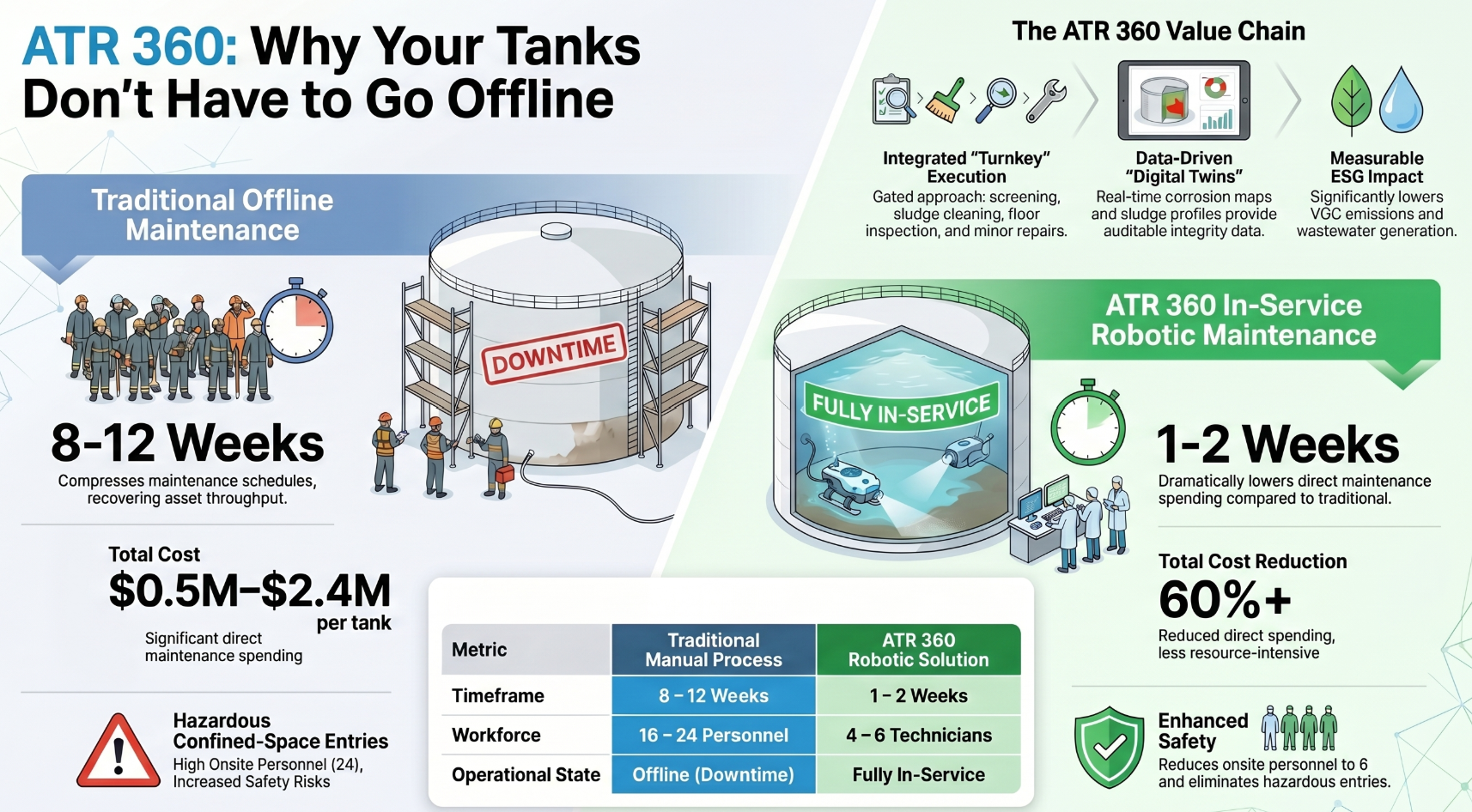
Eight to twelve weeks of downtime per tank. Sixteen to twenty-four workers mobilized. Between $0.5M and $2.4M in direct costs. Confined-space entries that remain among the most hazardous jobs in our industry. All of it to perform maintenance that, in principle, hasn't changed much in decades — drain the tank, degas it, scaffold it, send people in, and hope the schedule holds.
Every operator I speak with tells me the same thing: whether they run refineries on the Gulf Coast, terminals in Rotterdam, or FPSOs off West Africa, this process is overdue for reinvention. The economics are punishing. The safety exposure is real. And the integrity data coming out the other end rarely justifies the disruption it took to get it. That is exactly why we built ATR 360.
A different model: in-service, certified, data-driven
ATR 360 is a turnkey robotic tank maintenance and monitoring solution built around a simple idea — your tank should not have to come out of service for you to understand its condition, or to do something about it.
Our fleet of HazLoc-certified submersible robots performs assessment, cleaning, inspection, repair, and continuous monitoring while the tank remains in operation. Each mission feeds our Tank Intelligence Platform, which turns raw robot data into a real-time digital twin of the asset: corrosion maps, floor thickness profiles, sludge distributions, and structural condition — all auditable, all integrable with your existing ERP and CMMS.The impact on a typical maintenance cycle is dramatic. Where the conventional approach requires 16–24 workers over 8–12 weeks, ATR 360 delivers the same scope with 4–6 technicians in 1–2 weeks. That is a 60%+ reduction in total maintenance cost, weeks of recovered throughput, and a step change in the quality of data you carry into your next turnaround.
What that actually changes for your business
Economic value: Every week a tank is offline is a week of displaced products, lost storage capacity, and capital tied up in a non-producing asset. Compressing that window from months to weeks — and, in many inspection and maintenance use cases, eliminating downtime entirely — flows directly to the bottom line.
HSE outcomes: Every confined-space entry we can avoid is a worker who goes home safely. This is not a marketing line. It is the single reason many of our clients engaged us in the first place, and the one benefit that matters most to the teams actually doing the work.
Sustainability: In-service robotic cleaning uses significantly less water, generates less wastewater, produces less sludge waste, and substantially reduces the VOC emissions that accompany tank opening and degassing. For asset owners carrying public decarbonization commitments, this is a measurable contribution to Scope 1 targets — not a marginal one.
Decision quality: Manual inspection gives you a snapshot, often a blurry one, at a single point in time. ATR 360 gives you a continuously updated, AI-analyzed view of asset health, remaining life, and risk. Fitness-for-service and asset life-extension decisions become engineering conversations grounded in data, rather than judgment calls defended in hindsight.
Built for the way our clients actually work
Our approach is deliberately stepwise. We screen your tank portfolio and prioritize by risk and economics. We plan the mission with your operations and integrity teams. We execute — assess, clean, inspect, repair — with modular, interchangeable tooling designed for side-entry and top-entry tank configurations. And we stay connected to the asset through resident sensors that track leak detection, sludge profile, temperature, pressure, and VOC levels long after our field team demobilizes.
You don't adopt a new maintenance model overnight. We know that. Which is why ATR 360 is designed to slot into the integrity management frameworks, API 653 workflows, and procurement structures you already run — not to replace them.
Where we are, and where we're going
In 2024 and 2025 we executed projects across North America and Europe. In 2026 we will extend these capabilities to other key regional markets including South America, MENA and Africa. We are completing IECEx, ATEX, and NEC HazLoc certifications, expanding our fleet of HazLoc-certified mobile-platform robots, and building out regional partnerships across our key markets. Our primary goal is to ensure our full capabilities are locally available to our clients.
That is the commitment behind ATR 360.
If you are scoping your next turnaround, rethinking your inspection campaign, or trying to close the gap between the integrity data you have and what your engineers actually need to make better decisions, I'd welcome the conversation.
Your tanks are critical energy infrastructure. They deserve a maintenance model built for the decade we're actually in.