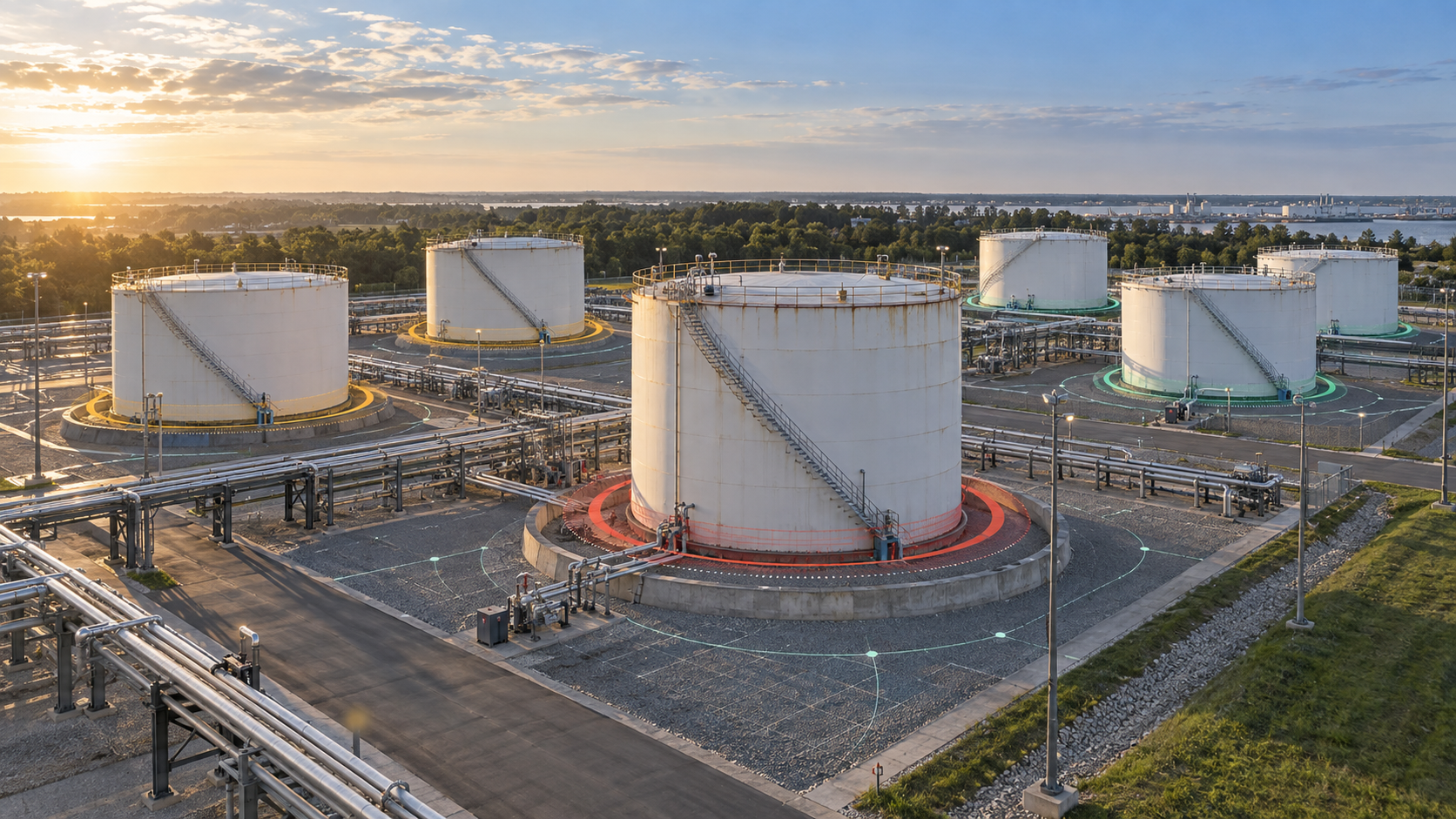
The problem with equal priority maintenance
Across many tank farms and terminal facilities, maintenance budgets are under constant pressure. Asset portfolios continue to age, regulatory expectations continue to increase, and operators are expected to improve reliability while controlling costs.
The reality
Every tank cannot receive the same level of attention at the same time.
Historically, many maintenance programs treated assets similarly, relying on scheduled inspections and predefined intervals. Structured programs remain important, but they do not always reflect actual risk.
Equal-priority maintenance leads to
- Resources allocated inefficiently
- Critical issues receiving delayed attention
- Maintenance budgets stretched unnecessarily
- Increased risk exposure across the facility
Risk-based ranking solves this by
- Focusing attention where it matters most
- Matching investment to actual risk profiles
- Directing resources to highest-impact assets
- Reducing portfolio-wide risk exposure
Understanding risk-based ranking
Risk-based ranking evaluates assets using two primary factors: probability of failure and consequence of failure.
Probability of failure (PoF)
- Corrosion rates
- Tank age
- Inspection findings
- Settlement trends
- Historical performance
- Operational conditions
Consequence of failure (CoF)
- Safety risks
- Environmental exposure
- Regulatory implications
- Product loss
- Business interruption
- Reputational damage
Combining these factors allows operators to rank assets according to overall risk and prioritize maintenance accordingly.
Data quality
Risk models are only as effective as the data supporting them. Without accurate and current information, risk rankings may be based on assumptions rather than reality.
From static assessments to dynamic risk intelligence
Traditional risk rankings are often updated only after major inspections. Modern asset intelligence platforms allow risk profiles to evolve as new information becomes available.
Track degradation trends continuously: Monitor corrosion, settlement, and coating condition between scheduled inspections.
Update risk assessments frequently: Refresh probability-of-failure inputs as new data arrives, not just after the next outage.
Identify emerging threats earlier: Surface developing issues before they reach the threshold that triggers unplanned intervention.
Improve capital allocation: Make informed decisions about where to invest maintenance budget based on current, not historical, risk.
ATR 360 and risk-based planning
ATR 360 was designed to help operators turn asset data into actionable intelligence.
HazLoc-certified robotic inspections: In-service inspection without conventional drain and degas, providing current condition data.
Advanced NDE technologies: Thickness mapping, corrosion rate analysis, and floor scanning to quantify probability of failure.
Laser scanning and digital twins; Dimensional assessments and digital twin development for geometry verification and risk visualization.
Asset intelligence workflows: Historical maintenance records and inspection findings integrated into a unified platform for risk-based decisions.
Rather than relying solely on periodic inspection snapshots, operators gain a more comprehensive understanding of asset condition and changing risk profiles.
Digital twins and risk visualization
Digital twins are becoming increasingly valuable within risk-based integrity programs. By integrating inspection findings, geometry, operational history, degradation trends, and maintenance records into a single environment, operators can visualize risk across entire asset portfolios.
What digital twin risk visualization enables
- Risk communication improved across engineering, operations, and leadership
- Maintenance planning optimized against a current view of the portfolio
- Decisions made with engineering-grade confidence
- Long-term asset strategy grounded in clarity rather than assumption
The future of maintenance planning belongs to organizations that can identify where risk is changing and act before minor degradation becomes a major operational event.
About the author
Damien Goodyear
Damien Goodyear is the Chief Operating Officer of Agellus Tank Robotics, responsible for operational strategy, technology deployment, and delivery performance across ATR's global operations. Damien brings extensive experience scaling inspection and asset integrity services in the Oil & Gas sector